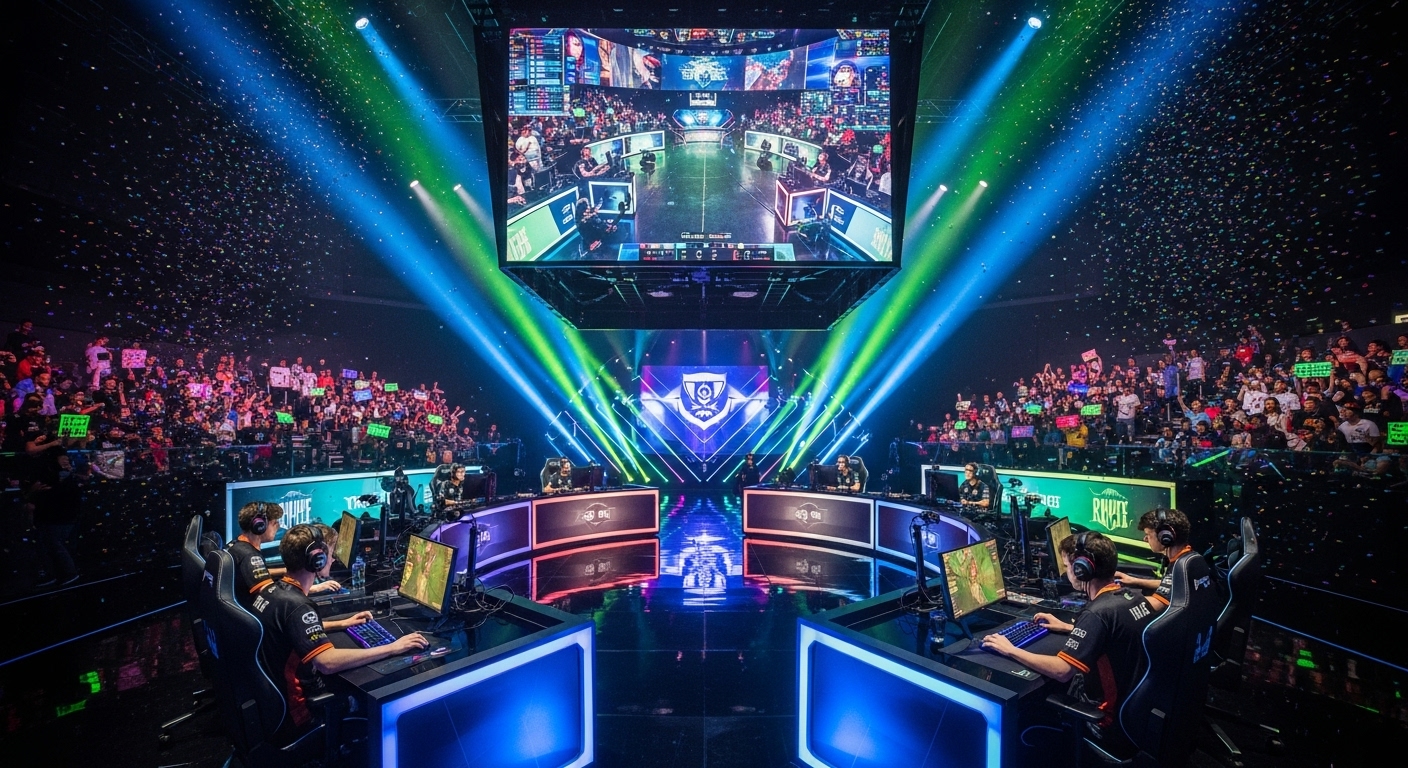
Esports, once an obscure hobby played in basements and local arcades, has quickly evolved into a global entertainment industry that commands millions of viewers, lucrative sponsorships, and international tournaments. With its rising popularity, esports has secured its place in the cultural zeitgeist alongside traditional sports. What began as a niche competition between friends has transformed into a multi-billion-dollar industry with professional players, sponsorships from major brands, and a vibrant, worldwide community.
In this blog post, we will explore the journey of esports, its cultural impact, the driving forces behind its growth, and its future trajectory as a dominant force in entertainment.
Understanding Esports: What Exactly is It?
Esports, short for electronic sports, is organized multiplayer video game competition, often between professional players, teams, or even entire organizations. Competitions are usually held in real-time and involve players facing off in a variety of video game genres, such as first-person shooters, real-time strategy games, and multiplayer online battle arenas. Games like League of Legends, Dota 2, Counter-Strike: Global Offensive, and Fortnite are some of the most popular titles in the esports world.
Esports is not just about playing games—it’s about competition, strategy, skill, and community. Unlike casual gaming, which many play for fun and relaxation, esports requires a high level of dedication and expertise. Players practice for hours each day, develop deep strategies, and work as teams to outwit and outplay their opponents.
What sets esports apart from other forms of gaming is its organized structure. Competitions are often held in the form of tournaments or leagues, and these events are streamed live for millions of viewers across the globe. Much like traditional sports, esports requires preparation, analysis, and professional coaching to perform at the highest level.
The Origins of Esports: From LAN Parties to Global Competitions
The origins of esports can be traced back to the late 20th century when gaming enthusiasts began competing in local events. The first major tournaments were held at LAN (Local Area Network) parties, where players would connect their computers together to play multiplayer games in the same physical location. These events were small, community-driven affairs, with participants often competing just for fun and bragging rights.
In 1997, one of the first recognized esports tournaments, the Red Annihilation tournament for Quake, took place. The tournament was a turning point, as it featured a cash prize and attracted a significant number of players. This event helped to establish the idea that esports could be more than just a casual activity—it could be a professional pursuit.
As the internet became more accessible in the late 1990s and early 2000s, the rise of online gaming platforms like Battle.net (Blizzard’s online service for Warcraft and StarCraft) provided a new way for players to compete across the globe. With the rise of games like StarCraft, Warcraft III, and Counter-Strike, organized tournaments began to grow in size and prestige. The Cyberathlete Professional League (CPL), founded in 1997, was one of the first organizations to host professional-level tournaments, laying the groundwork for what would later become the esports industry.
However, it wasn’t until the early 2000s that esports began to reach a larger audience, with games like StarCraft in South Korea becoming a national obsession. The professionalization of esports was accelerated by the creation of dedicated esports leagues and organizations like the Korean e-Sports Association (KeSPA), which helped elevate esports into a legitimate sport in South Korea. The country’s broadcasting networks even started airing StarCraft tournaments, drawing millions of viewers.
The Golden Age of Esports: Streaming and International Competitions
The 2010s saw a boom in the esports industry, driven in part by technological advancements and the rise of online streaming platforms. Platforms like Twitch revolutionized the way fans consumed esports content. Players and teams could now broadcast their gameplay in real-time to a global audience, giving rise to new kinds of fan interaction and community engagement. Twitch, in particular, became the epicenter of esports streaming, offering live coverage of everything from local tournaments to global championships.
The success of League of Legends (LoL) in the early 2010s played a pivotal role in esports’ mainstream breakthrough. LoL, developed by Riot Games, became one of the most watched games in the world, and the League of Legends World Championship became one of the biggest annual esports events. The 2013 finals attracted over 32 million viewers, and the tournament featured a massive prize pool. The game’s success spurred the growth of other titles and contributed to esports being recognized as a legitimate, professional industry.
At the same time, other games like Dota 2, Overwatch, and Counter-Strike: Global Offensive helped expand esports’ reach. Dota 2, for instance, became known for having one of the largest prize pools in esports history, with The International (TI) tournament attracting millions of viewers and participants from all over the world. The esports ecosystem was evolving rapidly, with teams, players, and organizations being supported by sponsorships, media rights, and broadcasting deals.
The recognition of esports as a legitimate industry also prompted the creation of professional esports leagues, including the Overwatch League and Call of Duty League, which began to mirror the structure of traditional sports leagues, offering a more formalized approach to competitions.
The Rise of Esports Stars: Professional Players and Teams
The evolution of esports from a grassroots community to a professional industry would not have been possible without the rise of skilled players and organizations. Esports stars are now some of the most recognized figures in gaming, with large followings on social media, sponsorship deals with major brands, and lucrative tournament earnings.
Top players like Faker (Lee Sang-hyeok), who has dominated League of Legends for years, and N0tail (Johan Sundstein), a highly successful Dota 2 player, have become household names in the esports community. These players are not just skilled gamers; they are influencers, role models, and content creators, inspiring millions of fans worldwide.
Teams like Cloud9, Team Liquid, Fnatic, and T1 have become iconic brands in the esports space, attracting sponsorships from major companies and building a loyal fan base. These teams recruit top players, invest in coaching staff, and provide extensive support for their players’ careers. The structure of esports teams now mirrors that of traditional sports teams, with staff dedicated to player development, marketing, and logistics.
As esports continues to grow, so does the level of competition. Professional players are now full-time athletes, dedicating themselves to training, strategy, and game analysis in much the same way as traditional athletes in sports like basketball or football.
The Economics of Esports: Sponsorships, Media Rights, and Revenue Streams
Esports has become a massive economic force, with a range of revenue streams contributing to its growth. In 2021, the global esports industry was valued at over $1 billion, with projections for continued growth in the years to come. Sponsorships, media rights, merchandising, and ticket sales have all become major revenue sources for esports organizations.
Sponsorships and Advertisements
Sponsorships have become a crucial aspect of the esports ecosystem. Major brands like Intel, Coca-Cola, Red Bull, and Adidas have recognized the value of esports as a way to reach a young, tech-savvy audience. These companies sponsor teams, tournaments, and events, providing financial support in exchange for brand visibility and advertising opportunities.
The appeal of esports to brands is clear. With millions of young, engaged viewers, esports provides a highly targeted platform for advertising. Moreover, esports sponsorships often extend beyond traditional media, allowing brands to engage with fans directly through streaming platforms and social media.
Media Rights and Broadcasting Deals
Media rights have become another significant revenue stream for esports. Major broadcasting platforms like Twitch, YouTube, and Facebook Gaming compete for the rights to stream esports tournaments and events. These media rights deals have transformed esports into a global phenomenon, with millions of viewers tuning in to watch top-tier competitions.
The growing popularity of esports has also led to partnerships with traditional sports networks like ESPN and TBS, which now air esports events on television. These partnerships help further legitimize esports and provide an additional revenue stream through advertising and broadcasting rights.
Prize Pools and Merchandise Sales
Prize pools for major esports tournaments have skyrocketed in recent years. The International (TI), for example, has consistently offered one of the largest prize pools in esports, with the 2021 tournament offering a total prize pool of over $40 million. This massive funding is partly driven by crowdfunding, where fans contribute to the prize pool through in-game purchases.
Merchandise sales, including team jerseys, gaming peripherals, and other esports-related products, also contribute to the financial success of the industry. Esports fans are passionate about their favorite teams and players, often purchasing merchandise to show their support.
The Future of Esports: Global Expansion and Technological Advancements
Looking ahead, the future of esports is filled with exciting possibilities. As the industry continues to grow, we can expect more innovations in broadcasting, player engagement, and gameplay technology.
One major area of development is the integration of virtual reality (VR) and augmented reality (AR) into esports. These technologies have the potential to revolutionize the way games are played and experienced, offering players and fans an entirely new level of immersion. VR esports could create fully immersive environments where players physically engage with the game, offering a more dynamic and interactive experience.